

Key Technical Resources


Dekleptification Guide - Seizing Windows of Opportunity to Dismantle Kleptocracy
This guidance is a resource for USAID staff working in countries trapped in severe corruption, particularly those whose courageous citizens open windows of opportunity for reform. It also aims to set the agenda for the broader community of donors, implementing partners, scholars, and other experts focused on countering kleptocracy and strategic corruption.

Safety/Security-Sensitive and Trauma-Informed Stakeholder Consultations with Members of Marginalized Groups
This document outlines practices that will assist USAID staff and implementing partners to conduct consultations with individuals and organizations of marginalized groups in a manner that is sensitive to their safety/security concerns and prior experiences of trauma.

USAID Guide: Strengthening and Working with Legislatures to Achieve Development Results
This Practitioner’s Guide provides practical advice for how to design, implement, and evaluate legislative strengthening and engagement projects.

Public Debt: A Primer for Development Practitioners
This primer covers key concepts and tools that are central to public debt theory and practice. Development stakeholders can use the contents of this primer to put the proper emphasis on public debt developments in their analysis and advice, and to understand appropriate roles that USAID and other partners can play. An improved ability to detect early warnings of debt vulnerabilities can help governments take timely and effective measures to mitigate risks, including productive approaches to debt restructuring. Good international practice derived from past cases will inform the discussion.

Report on ensuring research findings are put to use
The Utilization Measurement Analysis (UMA) is intended to provide the Evidence and Learning (E&L) team at the United States Agency for International Development (USAID) Center for Excellence in Democracy, Human Rights, and Governance (DRG) with a systematic review of uptake and use of its learning products.

Media Assessment Tool
The purpose of the Media for Democracy Assessment Tool (MAT) is to assist United States Agency for International Development (USAID) in producing media assessments to inform strategy on media and democracy programming, help inform potential media development programming goals, and help provide an informed understanding of where USAID investment is most feasible and needed and will have the best chances for impact. The MAT provides a standardized methodology to answer the key question: How do media connect to democracy and how can media support democracy promotion and civic space?

Democratic Decentralization Programming Handbook
The Democratic Decentralization Programming Handbook conceptualizes decentralization as a reform that advances democracy and development in a context of stability and the rule of law.

Digitized Autocracy Literature Review
The digital age changed the context in which authoritarian regimes operate. New technologies such as the Internet and social media reduced barriers to coordination, making it easier for ordinary citizens to mobilize and challenge unresponsive and repressive governments. Research shows that in the post-Cold War era protests have surpassed coups as the most common way that authoritarian leaders are ousted from office (Kendall-Taylor and Frantz, 2014). Authoritarian regimes, however, have adapted to this new challenge and learned to co-opt digital tools in ways that significantly shape political dynamics in their regimes.

Political Party Assistance Policy
A central purpose of political party assistance is to help parties become more representative and to reflect the interests of all social groups and citizens, not only a narrow elite.

INFORMED - Creating Learning Agenda in 8 steps
This document provides an overview of the eight steps that comprise the INFORMED approach to formulating learning questions and provides detailed instructions and resources on how to operationalize these steps. It is a step by step guide to help users formulate learning questions in a systematic and intentional way via three options for tailoring your formulation process to your needs and resources.

Disinformation Primer
This primer presents an overview of disinformation culture to give readers a sense of key concepts, terminology, select case studies, and programmatic design options.

Crime and Prevention Field Guide (Updated)
This Crime and Violence Prevention Field Guide (“Field Guide”) is designed to support USAID officers and other practitioners in the LAC region who are working on citizen security and in other sectors in which crime and violence prevention can be mainstreamed. It provides a conceptual framework for understanding crime, violence, and prevention as part of broader citizen security systems; evidence-based information about effective interventions to prevent crime and violence; and practical advice and tools on how to design, implement, measure, and evaluate crime and violence prevention and citizen security projects. T

USAID Electoral Assessment Framework
The Electoral Assessment Framework is intended to assist USAID DRG ofcers and other relevant United States Government (USG) personnel frst and foremost in assessing and prioritizing the challenges in the sector, and then developing a strategy to identify the best program options to promote credible elections. The guide helps prioritize investment of US taxpayer dollars and align assistance strategies with diplomatic strategies. Integral to this guide is USAID’s philosophy that technical assistance should continually build a country’s capacity to address its own development challenges, advancing it along its Journey to Self-Reliance.

Companion Toolkit: Electoral Assessment Framework
This document contains a compilation of tools and illustrative assessment questions from the United States Agency for International Development (USAID)’s Electoral Assessment Framework: A Tool to Assess Needs, Define Objectives, and Identify Program Options.

Advocacy in Restricted Spaces: A Toolkit for Civil Society Organizations
What this guide IS: a menu of options to encourage new ideas about conducting advocacy in difficult contexts.
What this guide IS NOT: a one-size-fits-all approach to advocacy that can be applied anywhere.

Rule of Law Practitioner's Guide
This Guide is designed for USAID personnel engaged in the day to day practice of Rule of Law (ROL) programming. The Guide serves as an adjunct document and should be used alongside the ROL Framework, not in place of it. The Guide summarizes new learning, describes available resources, but does not prescribe any one practice over another.
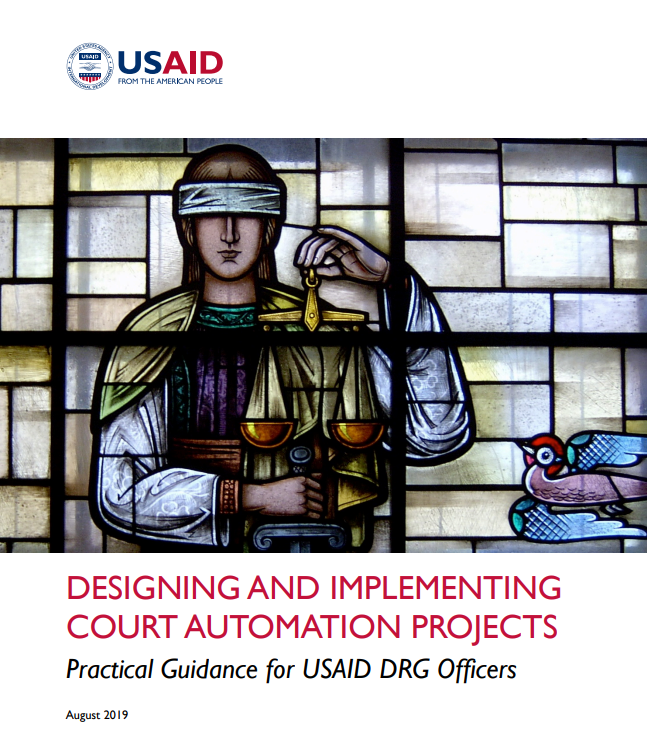
Designing and Implementing Court Automation Projects Guide
This guidance manual is based on reviews of reports, evaluations and assessments from numerous USAID projects from around the globe, as well as key informant interviews with DRG officers, chiefs of parties, court administrators, and others who have previously implemented or are currently implementing court automation projects. It has also been informed by the authors’ own experiences in designing, implementing, and managing multiple automation projects.
Missing Resource Form
See something missing? Want to add a missing resource? Fill out the form below. Thank you in advance.